
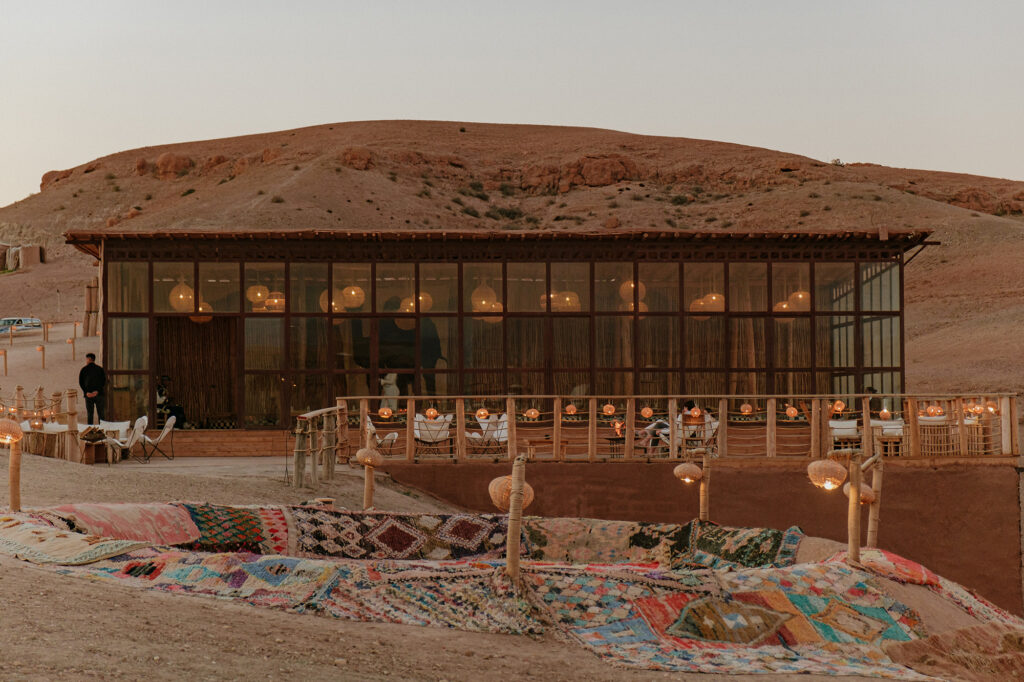
The Photographer’s Guide to Agafay: Capturing the “Blue Hour” and Desert Textures
Morocco is a country endlessly courted by the camera lens. The vibrant chaos of the Marrakech souks, the azure blue of Chefchaouen, and the towering orange dunes of Merzouga are staples of travel photography. Yet, just 45 minutes from Marrakech lies a landscape that offers a different kind of visual drama—a minimalist, lunar canvas that challenges and rewards the discerning photographer.
Welcome to the Agafay Desert.
Unlike its sandy cousins in the Sahara, Agafay is a stone desert (a reg). It is a vast expanse of rolling, arid hills, cracked earth, and deep, sedimentary layers that shift color with the moving sun. For the photographer, it is a study in texture and light.
At Alkamar Camp, we host many content creators and passionate photographers who come seeking the best desert camp experience in Morocco not just for the luxury, but for the unique visual opportunities our location affords. January, with its crystal-clear air and dramatic low sun, is perhaps the finest month to capture this environment.
This guide is designed to help you move beyond the standard camel-ride selfie and master the art of capturing the raw, textured beauty of Agafay, from the golden hour to the magical, fleeting “blue hour.”
1. Understanding the Subject: The “Lunar” Landscape
Before you lift your camera, you must understand what you are shooting. Agafay is defined by texture.
If the Sahara is about soft, flowing lines, Agafay is about brutalist form. The hills here look like spun concrete or petrified waves. The ground is a mosaic of weathered stones, dried riverbeds (oueds), and hardy, scrubby vegetation holding onto life.
The Macro World
Don’t just look at the horizon. Look down. The ground beneath your feet at Alkamar Camp is incredibly photogenic. The way the mud has cracked under the intense sun creates intricate geometric patterns. The lichen on the rocks introduces subtle greens and oranges into the monochromatic palette. A macro lens—or even a smartphone with a good macro mode—can reveal a universe of detail in a single square foot of desert floor.
The Layers of Time
Use a telephoto lens to compress the landscape. When you zoom in on distant hills, you begin to see the layers of sediment deposited over millennia. These striated bands of color—ochre, beige, dusty rose, and soft grey—create natural graphic patterns that are stunning in abstract compositions.
2. The January Advantage: Clarity and Low Sun
January is a secret weapon for photographers visiting Morocco. In the summer, the heat haze can soften distant details and bleach the sky into a pale white.
In winter, the air is crisp, cold, and incredibly free of dust and moisture. This results in high-definition visibility where distant peaks of the Atlas Mountains seem close enough to touch. Furthermore, the winter sun stays lower in the sky for longer. This means the “harsh light” of midday is shorter, and the desirable, raking light that elongates shadows and highlights texture lasts for hours instead of minutes.
3. Mastering the Golden Hour in Agafay
The “Golden Hour”—the hour after sunrise and the hour before sunset—is photography 101. However, in a stone desert, it behaves uniquely.
Because Agafay is made of rock and hard earth, it reflects light differently than sand. Sand absorbs light and glows; stone catches light and creates hard shadows. During the golden hour, every pebble casts a long shadow, turning the ground into a high-contrast texture field.
Composition Tip: Backlighting
Position yourself so you are shooting toward the sun (without blinding yourself). The low sun will rim-light the edges of the hills, the silhouettes of camels, or the canvas peaks of our luxury lodges, making them pop against the darkening landscape.
4. The Main Event: Capturing the “Blue Hour”
If Golden Hour is about warmth, the “Blue Hour” is about magic, mystery, and mood. This is the brief period of twilight after the sun has dipped below the horizon but before true darkness sets in.
In the desert, free from urban light pollution, the Blue Hour is profound. The sky turns a deep, saturated indigo that grades into violet near the horizon.
The Warm/Cool Contrast
This is the moment Alkamar Camp truly shines as a photographic subject. As the natural light turns deep blue, our camp lights—warm lanterns, fire pits, and the inviting tungsten glow from inside the tents—begin to assert themselves.
This creates the holy grail of photographic color contrast: complementary colors. The warm oranges and yellows of the camp against the deep cool blues of the desert sky create an incredibly striking image. It evokes a feeling of refuge, warmth, and luxury amidst the vast, cold emptiness.
Technique for Blue Hour:
- A Tripod is Non-Negotiable: Light levels are low. You will need shutter speeds ranging from 1 to 30 seconds. Handholding is impossible without blur.
- Low ISO: Keep your ISO low (100 or 200) to ensure the cleanest possible image without digital noise in the deep blue shadow areas.
- Aperture: Use a mid-range aperture (f/8 to f/11) to ensure everything from the immediate foreground tent to the distant mountains is in sharp focus.
- Timing is Everything: The peak balance between sky light and artificial camp light lasts maybe 15 minutes. Be set up early and shoot continuously as the light fades.
5. Integrating Luxury: The “Instagrammable” Morocco
As a luxury desert camp near Marrakech, Alkamar provides props that elevate landscape shots into aspirational travel imagery.
- The Infinity Pool Reflection: Our pool is designed to mirror the sky. On a calm January morning, use the water’s surface to create a perfect symmetrical reflection of the sunrise clouds or the distant Atlas mountains.
- Interiors and Exteriors: Capture the transition from the rugged outside to the plush inside. Open the flaps of your tent to frame the desert landscape, using the luxurious textiles and bedding of your lodge as a soft foreground frame. This tells the story of “comfort in the wild.”
- Dining Under the Stars: A long exposure shot of a private romantic dinner setup, lit only by candles with the Milky Way visible above, is the quintessential image of a luxury desert stay.
6. Practical Gear Guide for the Desert Photographer
Agafay is a forgiving environment compared to the sandy Sahara, but you still need to protect your gear.
- Lenses:
- Wide Angle (14mm-24mm): Essential for capturing the sheer scale of the landscape and the expansive sky.
- Mid-Range Zoom (24mm-70mm): Your workhorse for environmental portraits and general compositions.
- Telephoto (70mm-200mm+): Crucial in Agafay for compressing perspective, isolating distant layers of hills, and capturing camels or details far away.
- Filters: A Circular Polarizer (CPL) is highly recommended to deepen blue skies and cut glare from rocky surfaces. A Graduated Neutral Density (GND) filter can help balance a bright sunset sky with the darker desert ground.
- Dust Management: While it’s less sandy here, fine dust is still present. Avoid changing lenses when the wind is blowing. Bring a rocket blower and microfiber cloths to clean your front element frequently.
7. Conclusion: Seeing, Not Just Looking
Photography in the Agafay Desert is an exercise in patience and observation. It forces you to slow down and notice how light interacts with form. It’s not about snapping a hundred pictures in an hour; it’s about sitting on the terrace of your lodge at Alkamar Camp, watching the shadow creep across a distant hill, and waiting for the exact second the light reveals the texture you want to capture.
Whether you are a professional with a full kit or an enthusiast with a smartphone, Agafay in January offers a stunning, textured canvas for your creativity. Come stay with us, and let the desert fill your viewfinder.